Alborz artisans share their craft, passion and concerns
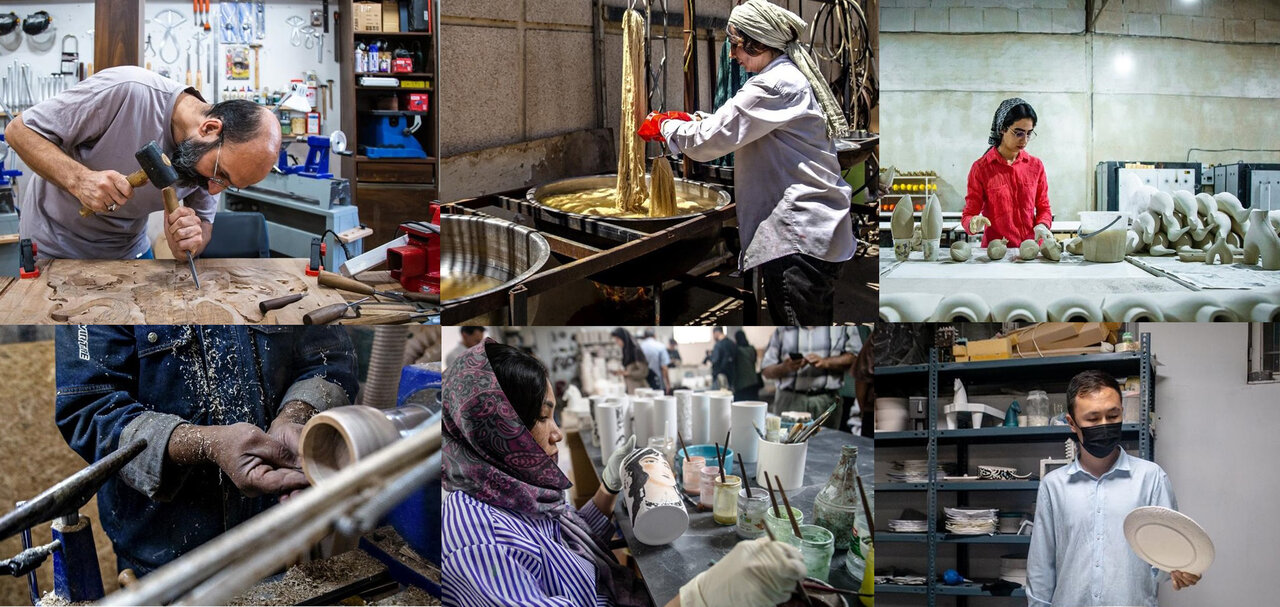
TEHRAN - World Handicrafts Day, observed annually on June 10, is an occasion to celebrate the creativity, skills and cultural heritage of artisans around the globe.
The day also marks the establishment of the World Crafts Council, an organization founded with the support of the United Nations Educational, Scientific and Cultural Organization (UNESCO) to promote traditional crafts and preserve cultural heritage worldwide.
To mark the occasion, the Ministry of Cultural Heritage, Tourism and Handicrafts organized a media tour for a group of journalists and cultural reporters from Tehran province. I joined fellow media professionals on a visit to several handicraft workshops across the nearby Alborz province, where we met artists, instructors and entrepreneurs who continue to keep traditional Iranian crafts alive despite economic challenges and changing market conditions.
The tour provided an opportunity to see firsthand how handicrafts are produced, how knowledge is passed to younger generations, and how artisans are adapting to new realities while preserving traditions that have been part of Iranian culture for centuries.
A woodturning master proud of his students
One of the first stops on our tour was the workshop of Yaser Yami, a woodturning artist and instructor whose name is well known among handicraft enthusiasts in Alborz province.
The sound of wood lathes filled the workshop as wooden pieces slowly took shape under skilled hands. Surrounded by tools and finished products, Yami spoke about his journey in the field. He has been active in woodturning since 1997 and has worked and taught in Karaj, the provincial capital, since 2006.
While many artisans proudly count the number of works they have produced, Yami measures success differently. For him, the greatest achievement is the number of students he has trained over the years.
Pointing to some of his former trainees, he explained that many have gone on to establish their own workshops and businesses. He spoke proudly about hundreds of students from different parts of Iran, from the north to the south of the country, who attended his courses and later became independent artisans.
“For me, education is more important than production,” he said. “Teaching a skill means creating jobs and helping preserve a traditional craft.”
Yet behind this success lies concern. According to Yami, handicrafts have increasingly become luxury products. As people's purchasing power declines, the domestic market for handmade products becomes smaller.
He also pointed to competition from industrial products manufactured by machines and sold at much lower prices. Such products, he said, make it difficult for handmade works to compete in the marketplace.
Despite these challenges, some of Yami’s products have found buyers abroad. He explained that his works are sold in European countries including Austria and the Netherlands, where some of his former students now operate galleries and workshops and help introduce Iranian handicrafts to international audiences.
His story demonstrated how traditional craftsmanship can create employment opportunities while also building cultural bridges beyond national borders.
A retired engineer dedicated to teaching
Our next visit took us to the workshop of Hassan Modarresirad, where wood shavings covered the floor and unfinished wooden projects rested on worktables.
Unlike many artisans, Modarresirad entered the handicraft sector after retirement.
Having spent many years working in construction engineering, he decided to dedicate his retirement to teaching woodworking arts. Since 2020, he has trained students in both practical skills and professional workshop techniques.
As he spoke about his students, his pride was evident. Several trainees who once learned in his workshop are now capable of managing independent businesses of their own.
Like other artisans we met, however, Modarresirad faces challenges. One of the biggest is the shortage of suitable space for training and production. He believes many more people could be trained if larger facilities were available.
Exporting products is another challenge. While foreign markets show interest in Iranian handicrafts, transportation costs reduce profitability for producers.
A place where threads, colors and tradition come together
The next destination offered a completely different atmosphere. Here, colors replaced wood shavings and spinning fibers replaced the sound of machinery.
This was the workshop of Leila Salmani, a handicraft artist and researcher specializing in kilim weaving and natural dyeing.
Large dyeing pots stood in one corner while colorful yarns hung from overhead racks. Salmani explained that her workshop is the only registered natural dyeing workshop in Alborz province.
The journey to establish it was long and demanding. She recalled traveling to cities such as Isfahan, Shiraz, Mashhad, Ardabil and Yazd to obtain knowledge and materials needed for her work.
According to Salmani, many of her international customers, particularly from Europe, requested unique color shades that were difficult to obtain. Rather than relying on outside suppliers, she decided to learn natural dyeing herself and gradually built the facilities needed for production.
Her beginnings were humble. “Everything started with a single pot,” she recalled.
What started on a very small scale has grown into a workshop that now supplies part of the dyeing needs of carpet and kilim producers in the province.
Salmani believes Alborz has significant potential in the field of carpets and handicrafts. However, she says specialized infrastructure remains limited. She noted that many carpet workshops operate in the province and that a larger dyeing and support center could help meet the needs of local producers.
Her academic studies have also contributed to her success. She has studied carpet design, raw materials and dyeing methods, enabling her to oversee every stage of production, from design and spinning to dyeing and weaving.
Traditional spinning wheels and old tools throughout the workshop reflected the close connection between handicrafts and Iran’s cultural heritage.
Interestingly, Salmani expressed confidence about the future of handicrafts in an age increasingly shaped by technology and artificial intelligence.
Unlike many who fear technological change, she believes handicraft professions enjoy a high level of security because their value lies in uniqueness.
Every color, pattern and texture, she said, is the result of human experience and creativity. These qualities cannot be fully replicated by machines or robots.
Her confidence highlighted one of the enduring strengths of handicrafts: authenticity.
When handicrafts become luxury products
The media delegation then visited a pottery and ceramics workshop where shelves were lined with ceramic objects, sculptures and decorative pieces, each reflecting a blend of artistic imagination and technical skill.
Talking to reports, the workshop’s owner Farzad Faraji explained that handicrafts have undergone significant changes in recent decades. “In the past, handicraft workshops served the role that factories serve today,” he said. “They produced everyday items that people needed.”
Some of his products are sold domestically while others reach international markets. He also produces works commissioned by organizations, institutions and private clients.
Today, however, industrial production dominates many sectors. As a result, handicrafts have moved toward more specialized and luxury markets, he explained.
Faraji attributes this transformation partly to changing lifestyles and partly to the influence of a younger generation of artists, designers and graduates of art schools. Their work often emphasizes creativity, aesthetics and decoration.
While this evolution has elevated the artistic value of handicrafts, it has also created new vulnerabilities.
According to Faraji, luxury products are often the first items consumers stop buying during economic difficulties and the last items they purchase again when conditions improve.
He also noted that handicraft producers face significant disadvantages when competing with mass-produced industrial goods. Rising costs of raw materials, energy and labor make price competition extremely difficult.
Despite these obstacles, Faraji remains optimistic. He believes cultural products represent one of the most important economic resources available to countries after natural resources.
“The future exists,” he said. “But producers must understand society’s needs and respond to them.”
Handicrafts as representatives of Iranian identity
Another memorable stop introduced us to Nafiseh Khalaj and Mohammad Ta’ebi, a husband-and-wife team who have spent more than twenty years working in ceramics and pottery. Rows of ceramic vessels and artistic sculptures filled their workshop. Every piece seemed to carry its own personality through color, form and design.
The couple explained that they never wanted to be merely producers. Their goal has always been to create products that are useful in modern life while also reflecting Iranian culture and identity.
Their workshop produces around 2,000 pieces annually. Some remain in Iran, while others are exported abroad. Over the years, their products have reached more than fifteen countries, with France becoming their most important export destination.
Yet exporting handicrafts is not easy. The couple pointed to high transportation and customs costs as major obstacles. Economic instability also makes long-term planning difficult. However, their greatest concern is not the market itself.
Ta’ebi highly underlined the importance of design, creativity and continuous learning. In his view, handicrafts cannot rely solely on technical skills. Successful products require knowledge of form, proportions, function and artistic development.
Where creativity declines, imitation takes its place, he warned.
For Khalaj and Ta’ebi, cultural identity is the most valuable asset of Iranian handicrafts and the key factor that distinguishes them from similar products around the world.
A vision for Alborz’s future
At the conclusion of the tour, Zhila Khodadadi, Deputy Director of Handicrafts at the Alborz Cultural Heritage, Tourism and Handicrafts Department, provided a broader picture of the province’s achievements. She said 122 artists in Alborz hold national quality seals, while nine have received international quality seals.
According to Khodadadi, more than 2,000 people participated in handicraft training programs in the province during the past year. Many of these programs were conducted in public centers, welfare institutions and prisons.
She also highlighted Golestanak Village, which received the title of National Pottery and Ceramics Village in 2024 and is now home to dozens of active workshops.
The next goal, she said, is to establish pottery and ceramics as a recognized souvenir of Alborz province.
If achieved, this vision could place Alborz among provinces identified by a signature artistic product that carries both cultural and economic value.
More than products
As the media tour came to an end, what remained most memorable was not the number of workshops visited or the production statistics presented. It was the people.
Each workshop revealed individuals who continue to believe in the value of making things by hand. Despite economic pressures, rising costs and export challenges, they continue creating, teaching and innovating.
Through wood, clay, yarn and color, they create objects that are more than products. They are expressions of memory, identity and culture, helping preserve the cultural heritage of Iran for future generations.
AM
Leave a Comment